Artificial Intelligence in Business: How AI is Transforming Industries in 2026
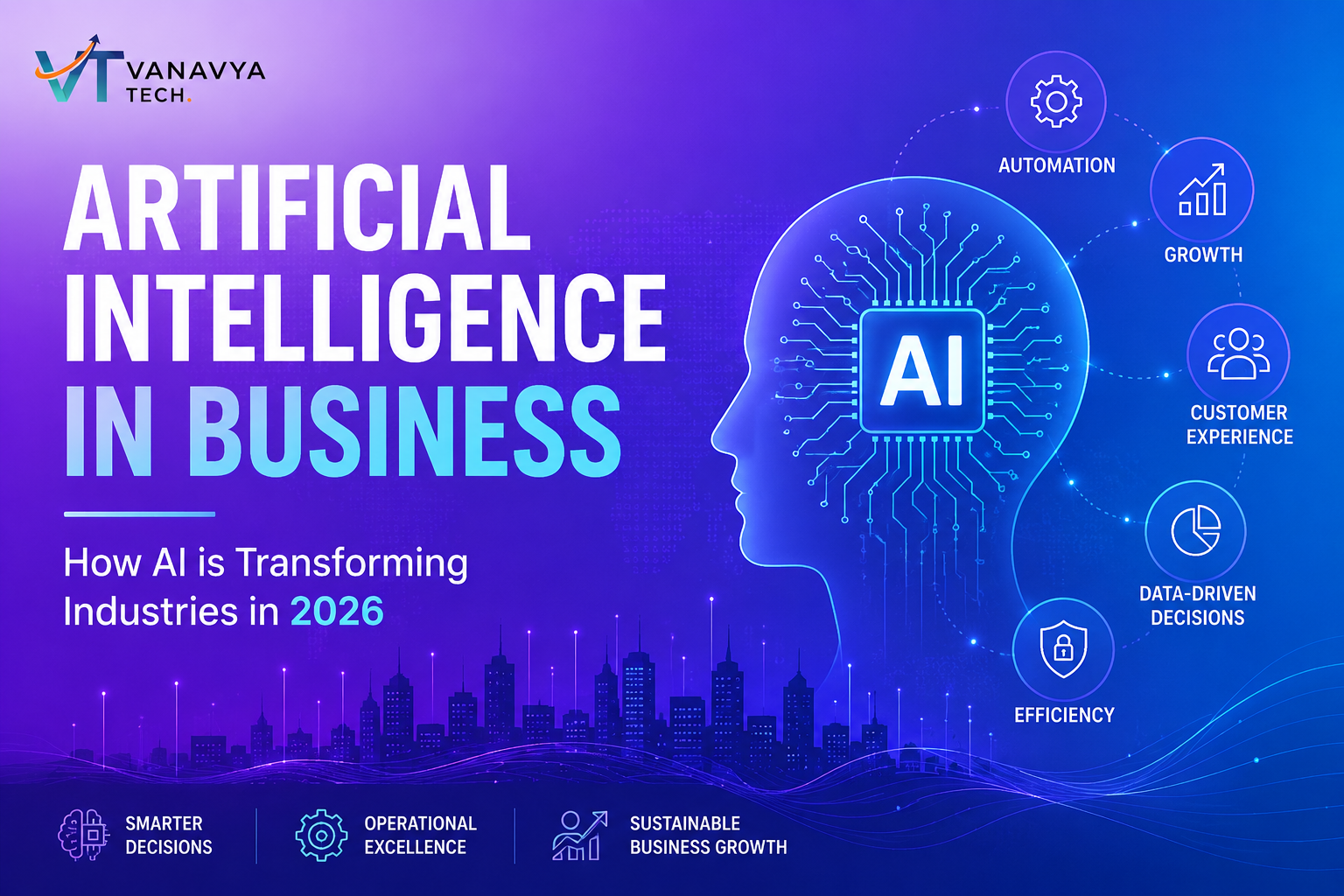
Artificial Intelligence (AI) is no longer a futuristic concept. It has become a powerful business tool that is reshaping industries, improving customer experiences, and driving operational efficiency across the globe. From startups to large enterprises, organizations are leveraging AI to automate processes, analyze data, and make smarter decisions. As we move through 2026, AI is becoming one of the most important technologies influencing business growth and innovation. Companies that embrace AI are gaining a competitive advantage, while those that hesitate risk falling behind in an increasingly digital world.
What is Artificial Intelligence?
Artificial Intelligence refers to computer systems that can perform tasks typically requiring human intelligence. These tasks include learning from data, recognising patterns, understanding language, solving problems, and making decisions.
- Modern AI technologies include:
• Machine Learning (ML)
• Natural Language Processing (NLP)
• Generative AI
• Computer Vision
• Predictive Analytics
• Intelligent Automation
These technologies help businesses improve productivity and unlock new growth opportunities.
Why AI Matters for Businesses in 2026
A few years ago, artificial intelligence felt like something reserved for large tech companies with massive budgets and specialised teams. Today, that perception has completely changed.
Whether it's a startup trying to automate customer support, a manufacturing company reducing downtime, or a retail business understanding customer preferences, AI has become accessible to
organisations of all sizes.
The reason is simple: businesses are generating more data than ever before. Every customer interaction, website visit, purchase, and operational process creates valuable information. The challenge is no longer collecting data; it's making sense of it.
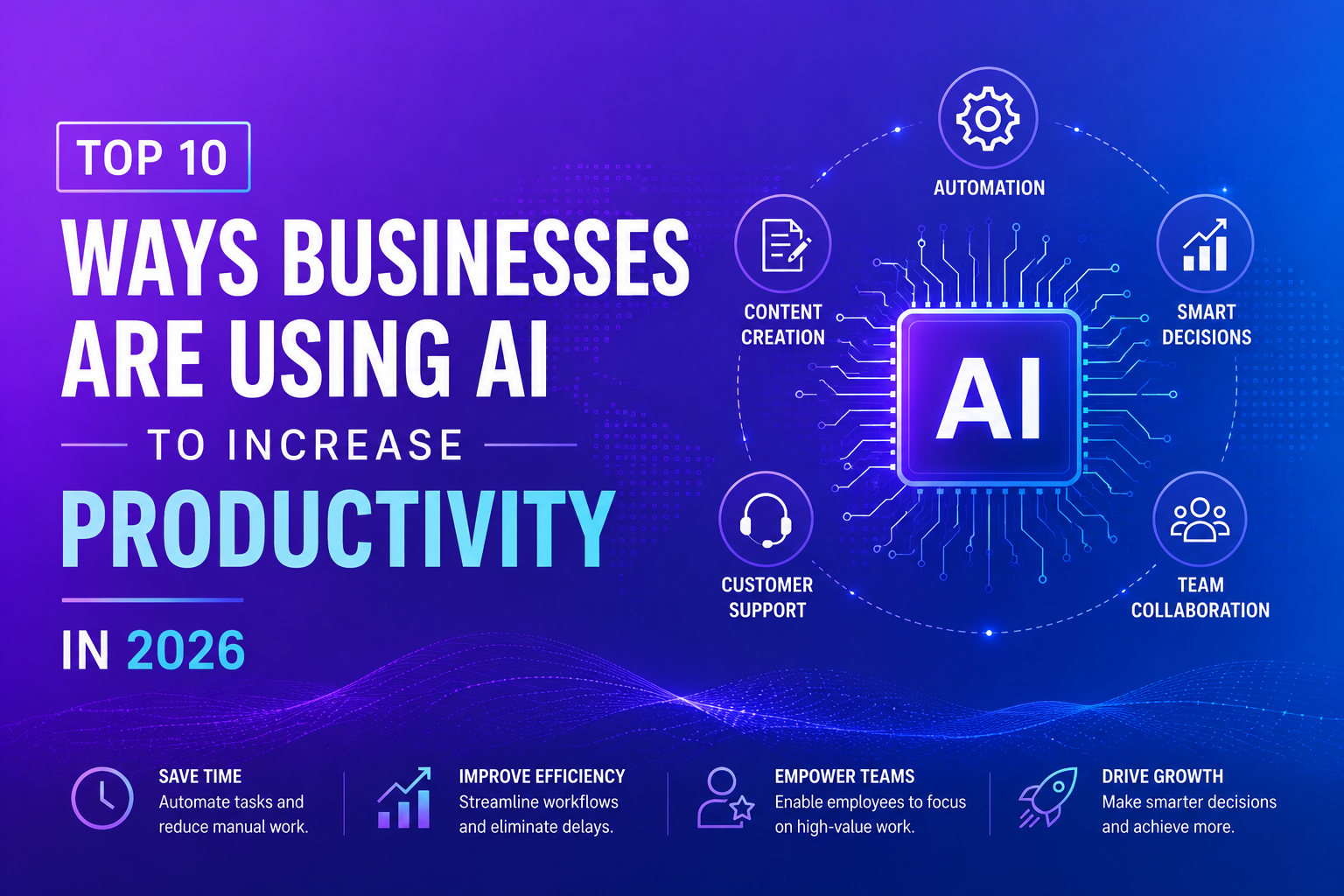
This is where AI creates real impact. Instead of spending hours analysing spreadsheets or manually performing repetitive tasks, businesses can use AI to identify patterns, predict outcomes, and uncover opportunities that would otherwise go unnoticed. The result is faster decision-making, improved efficiency, and a stronger ability to adapt to changing market conditions.
Companies that successfully adopt AI are not replacing human expertise. They are empowering their teams with better tools, allowing employees to focus on creativity, innovation, and strategic thinking while AI handles routine processes in the background.
Key Benefits of Artificial Intelligence in Business
1. Improved Operational Efficiency
AI-powered automation eliminates repetitive and time-consuming tasks. Businesses can automate data entry, scheduling, reporting, and customer interactions, allowing employees to focus on higher
value activities.
2. Better Decision-Making
AI systems can analyse historical and real-time data to identify trends and predict outcomes. This enables leaders to make informed decisions based on accurate insights rather than assumptions.
3. Enhanced Customer Experience
Modern consumers expect personalised experiences. AI helps businesses understand customer preferences and deliver tailored recommendations, faster support, and more relevant communication.
4. Cost Reduction
Automation reduces the need for manual intervention, helping organisations save time and operational expenses. AI also minimises errors, leading to improved efficiency and reduced costs.
5. Increased Business Scalability
AI solutions allow companies to handle growing workloads without significantly increasing resources. This makes scaling operations more efficient and sustainable.
Real-World AI Use Cases Across Industries
Healthcare - AI is helping healthcare providers improve diagnostics, patient monitoring, and treatment planning. Advanced algorithms can analyse medical data and support healthcare professionals in delivering better outcomes.
Finance - Financial institutions use AI for fraud detection, risk assessment, customer service automation, and investment analysis. AI helps improve security while enhancing customer experiences.
Retail and E-commerce - Retail businesses use AI to recommend products, optimise inventory management, and forecast demand,
and personalise marketing campaigns.
Manufacturing - AI-powered predictive maintenance helps manufacturers identify equipment issues before failures occur, reducing downtime and improving productivity.
Education - Educational institutions are using AI-driven learning platforms to create personalised learning experiences and improve student engagement.
The Rise of Generative AI
One of the most talked-about developments in recent years has been the rise of Generative AI. Unlike traditional AI systems that focus primarily on analysis and prediction, Generative AI can create entirely new content. From writing articles and generating marketing copy to producing images, software code, and business reports, these tools are transforming how work gets done.
For businesses, Generative AI offers an opportunity to increase productivity while reducing the time required for content creation and research. However, successful adoption requires balance. While AI can accelerate workflows, human expertise remains essential for maintaining accuracy, creativity, quality, and ethical standards.
The businesses seeing the greatest success are not replacing people with AI; they are enabling people to work more effectively alongside AI.
Challenges of AI Adoption
Despite its benefits, implementing AI comes with certain challenges.
Data Privacy and Security- Organisations must ensure that customer and business data remains secure and compliant with regulations.
Integration Complexity- Integrating AI with existing systems can require significant planning and technical expertise.
Workforce Adaptation-Employees may need training to effectively work alongside AI-powered tools and technologies.
Ethical Considerations- Businesses must address concerns related to transparency, bias, and responsible AI usage.
A strategic AI implementation plan can help organisations overcome these challenges and maximise long-term value.
What the Future of AI Looks Like
The future of AI will be less about technology itself and more about how effectively businesses use it to create value. Automation will continue to expand, helping organisations eliminate repetitive work and improve operational efficiency. Customer experiences will become increasingly personalised as AI gains a deeper understanding of individual behaviours and preferences.
Cybersecurity will also benefit significantly from AI-driven threat detection systems capable of identifying risks in real time. Perhaps most importantly, we will see greater collaboration between humans and AI. Rather than replacing jobs, AI will increasingly serve as a partner that enhances human capabilities, enabling teams to make better decisions and solve more complex problems.
Industry-specific AI solutions will also become more common, helping organisations address unique challenges with greater precision and effectiveness.
How Businesses Can Start Their AI Journey
Organisations looking to adopt AI should begin with a clear strategy.
Key steps include:
1. Identify business challenges that AI can solve.
2. Evaluate available data and technology infrastructure.
3. Start with small pilot projects.
4. Measure performance and ROI.
5. Scale successful implementations.
6. Invest in employee training and change management.
A phased approach helps businesses minimise risks while maximising the benefits of AI adoption. Artificial Intelligence is transforming the way businesses operate, compete, and grow. From improving operational efficiency to enhancing customer experiences and enabling data-driven decision-making, AI has become a critical component of modern business strategy.
As AI technologies continue to evolve, organisations that embrace innovation and invest in intelligent solutions will be better positioned for long-term success. The future belongs to businesses that can effectively combine human expertise with the power of Artificial Intelligence.
At Vanavya Tech, we believe AI is not just a technology trend; it is a strategic enabler of business growth, innovation, and digital transformation. Organisations that start their AI journey today will be the ones leading tomorrow.
Join our Newsletter
Get the latest tech insights delivered straight to your inbox.