Agentic AI in 2026: Real-World Business Applications Beyond the Hype
Artificial Intelligence has evolved rapidly over the past few years. Businesses have moved from experimenting with chatbots and content generation tools to integrating AI into everyday workflows. Yet, as organizations become more familiar with AI, a new term has started dominating conversations across the technology landscape: Agentic AI.
Some call it the next phase of artificial intelligence. Others describe it as the bridge between AI assistance and AI execution. Regardless of the terminology, one thing is becoming increasingly clear. Agentic AI is changing how work gets done.
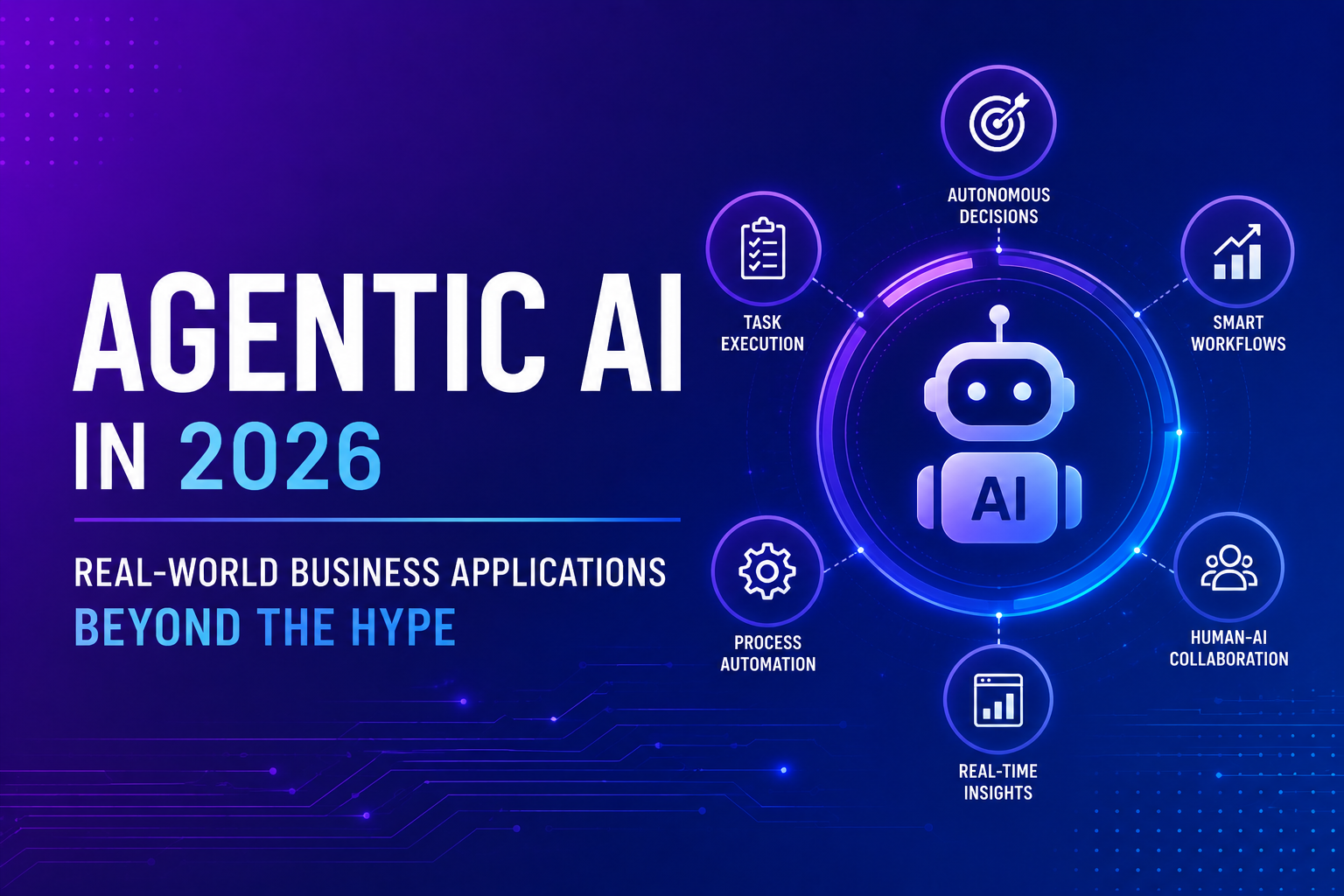
Unlike traditional AI systems that wait for instructions, Agentic AI can analyze situations, make decisions, use tools, and complete tasks with a higher level of autonomy. Instead of simply responding to prompts, it can actively pursue goals and take action on behalf of users.
The excitement surrounding Agentic AI is undeniable. However, beyond the headlines and industry buzz, businesses are asking a practical question:
What can Agentic AI actually do today?
The answer is far more interesting than many people realise.
What is Agentic AI?
Most people are familiar with AI assistants. You ask a question, and the system provides an answer.
Agentic AI works differently.
An AI agent is designed not only to understand instructions but also to plan actions, make decisions, interact with multiple systems, and complete tasks with minimal human intervention. It can remember context, use external tools, evaluate outcomes, and adapt its actions based on changing circumstances.
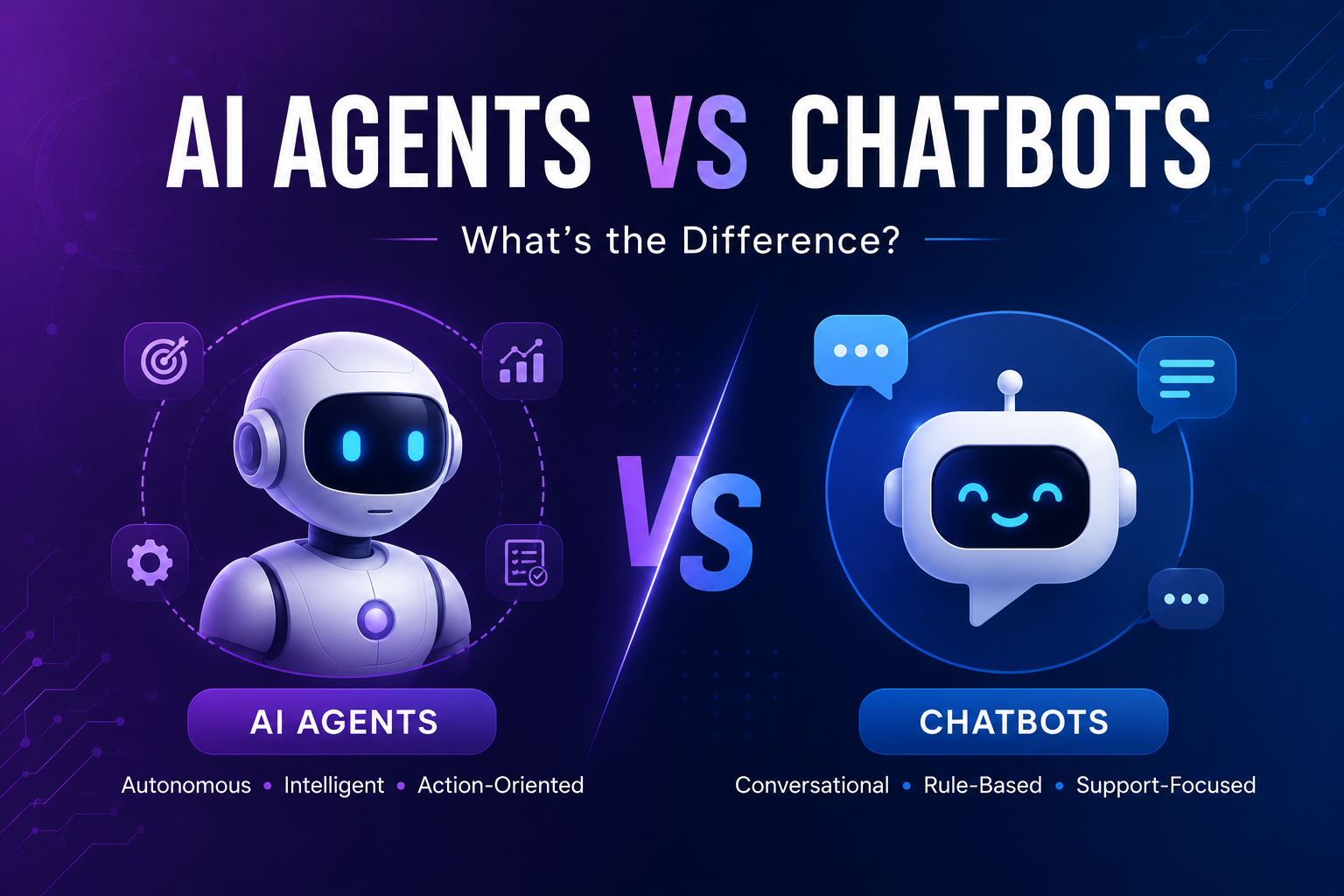
Think of the difference this way: A traditional chatbot helps you write an email. An AI agent can draft the email, find the recipient, schedule a meeting, update the CRM system, and notify relevant team members after receiving approval.
The shift is subtle but significant. Businesses are moving from AI that assists people to AI that actively participates in workflows.
Why Businesses Are Paying Attention
The growing interest in Agentic AI is not driven by curiosity alone.
Organisations face increasing pressure to improve productivity, reduce operational costs, and respond faster to changing customer expectations. As a result, many companies are investing in custom AI-powered solutions that can automate repetitive processes and streamline business operations.
Traditional automation has helped solve part of the problem, but many business processes still require constant human oversight.
Agentic AI introduces a new approach. Instead of automating individual tasks, it can automate entire workflows. Multiple AI agents can collaborate, share information, and execute complex processes from start to finish while keeping humans involved when necessary.
For business leaders, the appeal is obvious. Less time spent on repetitive coordination means more time focused on strategy, innovation, and growth.
Real-World Agentic AI Use Cases
One of the biggest misconceptions about Agentic AI is that it remains experimental. In reality, organisations are already deploying AI agents in practical business environments.
Customer Support That Goes Beyond Chatbots
Traditional support bots answer questions. Agentic AI can take action.
Imagine a customer reporting a delivery issue. Instead of simply providing information, an AI agent can investigate the order status, communicate with logistics systems, initiate a replacement request, update records, and notify the customer of the resolution.
The customer receives a faster response while support teams spend less time handling routine requests. These capabilities are often built into custom business software that helps organizations deliver faster and more consistent customer experiences. Enterprise AI agents are increasingly being used for these operational tasks.
Smarter Sales Operations
Sales teams often lose valuable time performing administrative work.
Modern AI agents are commonly integrated into web applications that connect CRM systems, communication tools, and sales workflows.
Agentic AI can qualify leads, gather prospect information, schedule follow-ups, update CRM systems, and even recommend the next best action based on customer behaviour.
Instead of spending hours managing data, sales professionals can focus on building relationships and closing deals. Similar applications are emerging across modern sales organizations.
Finance and Compliance Workflows
Finance departments manage highly structured processes that require accuracy and consistency. AI agents can assist with invoice processing, compliance checks, account onboarding, financial reconciliation, and risk monitoring. They can continuously monitor transactions and flag exceptions for human review rather than waiting for scheduled audits. This creates faster workflows while maintaining governance and oversight.
HR and Employee Operations
Human Resources teams spend significant time managing employee documentation, onboarding, payroll coordination, and benefits administration. Agentic AI can automate many of these activities by gathering required information, triggering approvals, updating systems, and guiding employees through various processes. Organisations are increasingly exploring these HR-focused use cases to improve operational efficiency.
Business Intelligence and Decision Support
One of the most powerful applications of Agentic AI is proactive decision-making. Instead of waiting for managers to request reports, AI agents can continuously monitor business metrics, identify emerging trends, and surface actionable insights.
Imagine receiving a notification that customer churn is increasing in a specific region, along with recommendations for corrective action before the problem impacts revenue.
This moves organizations from reactive decision-making toward proactive business management.
How Agentic AI Differs from Generative AI
Generative AI and Agentic AI are often discussed together, but they are not the same thing. Generative AI focuses on creating content such as text, images, code, and summaries. Agentic AI focuses on taking action.
A Generative AI tool can create a customer response. An Agentic AI system can generate the response, send it through the appropriate channel, update customer records, and monitor the outcome. In many cases, Agentic AI uses Generative AI as one of its capabilities,
but the defining characteristic is autonomy and execution rather than content generation alone.
The Challenges Organizations Must Address
While the potential is significant, Agentic AI is not without challenges. The greater the autonomy, the greater the need for governance.
Organisations must address concerns related to security, compliance, transparency, accountability, and operational control. Poorly governed AI agents can create unintended risks if they are allowed to make decisions without appropriate oversight.
This is why many successful implementations follow a human-in-the-loop model, where AI agents perform work while humans maintain strategic control and final approval for critical decisions.
Businesses that approach Agentic AI responsibly are likely to achieve better outcomes than those pursuing full automation without governance frameworks.
The Future of Agentic AI
The future of Agentic AI is not about replacing people. It is about enabling people to accomplish more. As these systems become more sophisticated, organisations will increasingly rely on networks of specialised AI agents that collaborate across departments, systems, and workflows.
Customer service, operations, finance, marketing, HR, and software development are all expected to see significant transformation through agent-based automation. Industry leaders are already investing heavily in enterprise agent ecosystems and agentic workflow platforms.
The businesses that gain the most value will not necessarily be those that deploy the most AI agents. They will be the organizations that successfully combine human judgment, business expertise, and intelligent automation.
Agentic AI represents a major step forward in the evolution of artificial intelligence. Rather than simply assisting users, AI agents can now plan, reason, execute tasks, and collaborate across workflows. This capability is helping organisations move beyond isolated automation and toward intelligent business operations.
While the technology is still evolving, practical use cases are already delivering measurable value across customer service, finance, sales, HR, and decision-making processes.
Join our Newsletter
Get the latest tech insights delivered straight to your inbox.