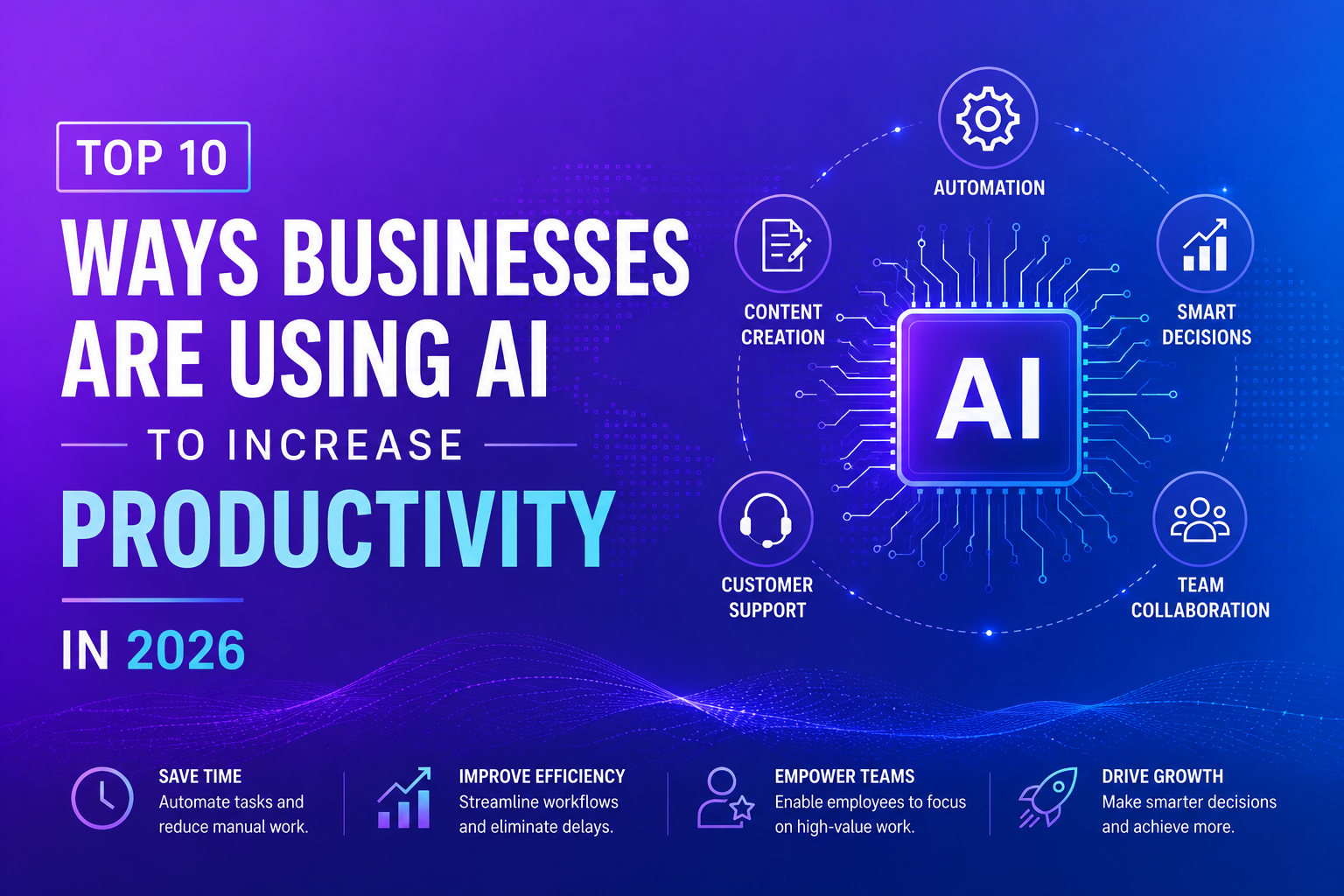
Top 10 Ways Businesses Are Using AI to Increase Productivity in 2026
Introduction
Productivity has always been one of the biggest drivers of business success. Organisations constantly look for ways to accomplish more with the same resources, reduce inefficiencies, and help employees focus on work that creates real value.
For years, businesses relied on process improvements, software tools, and automation to achieve these goals. Today, Artificial Intelligence (AI) is taking productivity to an entirely new level.
AI is no longer just a technology used by large enterprises. Businesses of all sizes are integrating AI into their daily operations to simplify workflows, improve decision-making, and eliminate repetitive tasks. Instead of spending hours on manual processes, teams can focus on innovation, strategy, and customer relationships. In 2026, AI is not simply helping organisations work faster; it is helping them work smarter.
Let's explore the top ways businesses are using AI to increase productivity and create a more efficient workplace.
1. Automating Repetitive Administrative Tasks
Every organisation has tasks that consume time without directly contributing to growth. Data entry, scheduling meetings, updating records, processing invoices, and organising files often require significant manual effort.
AI-powered automation tools are reducing this burden. Instead of spending hours on routine tasks, employees can rely on AI systems to complete them quickly and accurately. This not only saves time but also reduces the likelihood of human errors.
For many businesses, productivity gains begin with removing unnecessary administrative work from employees' daily responsibilities.
2. Improving Customer Support Efficiency
Customer expectations continue to rise. People expect quick responses, personalised assistance, and round-the-clock availability. AI is helping businesses meet these expectations without significantly increasing support teams.
Modern AI assistants can answer common questions, guide customers through processes, and resolve basic issues instantly. More importantly, they can handle large volumes of inquiries simultaneously.
This allows human support agents to focus on complex situations that require empathy, problem-solving, and personalised attention. As a result, businesses improve customer satisfaction while increasing operational efficiency.
3. Helping Teams Make Faster Decisions
One of the biggest productivity challenges in any organization is delayed decision-making. Employees often spend hours gathering information, analysing reports, and searching for insights before taking action.
AI accelerates this process by analysing large datasets in real time and presenting actionable recommendations. Instead of manually reviewing spreadsheets or reports, teams can quickly access meaningful insights that help them make informed decisions.
When employees spend less time searching for answers, they have more time to focus on execution and results.
4. Enhancing Workplace Collaboration
As businesses become increasingly distributed, collaboration has become more important than ever. AI-powered collaboration tools are helping teams communicate more effectively by summarising meetings, organising information, tracking action items, and improving project visibility.
Rather than spending valuable time reviewing lengthy notes or searching through conversations, team members can instantly access key insights and updates. This reduces communication gaps and helps projects move forward more efficiently.
The result is a workplace where information flows more smoothly and teams remain aligned on priorities.
5. Streamlining Content Creation and Marketing
Marketing teams often face pressure to produce content quickly while maintaining quality and consistency. AI is transforming how businesses approach content creation.
Teams can use AI to generate content ideas, create first drafts, optimize content for search engines, analyse audience behaviour, and personalize marketing campaigns. This doesn't replace human creativity. Instead, it removes time-consuming tasks and allows marketers to focus on strategy, storytelling, and audience engagement.
Organizations that effectively combine AI with human expertise are producing content faster while maintaining high standards.
6. Optimizing Business Operations
Many organizations struggle with inefficiencies hidden within their operational processes. AI helps identify bottlenecks that might otherwise go unnoticed. By analysing workflows, employee activities, customer interactions, and operational performance, AI can highlight areas where improvements are needed.
For example, a logistics company can use AI to optimize delivery routes. A manufacturing company can improve production schedules. A retail business can better manage inventory levels. Small improvements across multiple processes often result in significant productivity gains over time.
7. Supporting Smarter Project Management
Managing projects involves coordinating people, resources, deadlines, and priorities. AI-powered project management tools are helping organizations improve planning and execution. These systems can predict project risks, estimate completion timelines, identify resource constraints, and provide recommendations to keep projects on track.
Project managers gain greater visibility into potential issues before they become major problems. This proactive approach reduces delays, improves efficiency, and increases the likelihood of successful project outcomes.
8. Personalizing Employee Learning and Development
A productive workforce is a skilled workforce. However, traditional training programs often take a one-size-fits-all approach that may not address individual learning needs.
AI is changing this by creating personalized learning experiences. Employees can receive tailored recommendations based on their roles, skills, performance, and career goals. Learning platforms can adapt content dynamically, helping employees acquire knowledge more effectively. When employees learn faster and develop relevant skills, overall organizational productivity improves.
9. Strengthening Data Analysis and Reporting
Businesses generate enormous amounts of data every day. The challenge is transforming that information into meaningful insights. AI simplifies this process by automatically analyzing data, identifying trends, and generating reports that highlight what matters most.
Rather than spending hours compiling information manually, leaders can access real-time insights and make faster decisions. This allows organizations to become more agile and responsive in an increasingly competitive marketplace. The ability to act on data quickly often creates a significant productivity advantage.
10. Empowering Employees to Focus on High-Value Work
Perhaps the most important productivity benefit of AI is its ability to free employees from repetitive and low-value activities. Many professionals spend a large portion of their day performing routine tasks that do not fully utilize their expertise. AI helps shift that balance.
When technology handles administrative work, data processing, scheduling, reporting, and other repetitive functions, employees can focus on creativity, problem-solving, innovation, and strategic thinking. These are the activities that drive business growth and create competitive advantages. The goal of AI is not to replace people. It is to help people perform at their highest potential.
The Future of Productivity is Human + AI
One of the most common misconceptions about AI is that it exists to replace human workers. In reality, the most successful organizations are using AI as a productivity partner rather than a replacement. AI excels at processing information, identifying patterns, and automating repetitive work. Humans excel at creativity, emotional intelligence, leadership, and strategic thinking.
When these strengths are combined, businesses achieve outcomes that neither humans nor technology could accomplish alone. This partnership is shaping the future of work in 2026 and beyond.
Artificial Intelligence is transforming how businesses operate by helping teams work smarter, make faster decisions, and focus on meaningful work. From automating repetitive tasks and improving customer support to strengthening collaboration and optimizing operations, AI is creating measurable productivity improvements across industries. As organizations continue to embrace digital transformation, productivity will increasingly depend on how effectively they integrate AI into everyday workflows.
At Vanavya Tech, we help businesses leverage AI-driven solutions that improve efficiency, streamline operations, and unlock new opportunities for growth. Organizations that embrace AI today will be better positioned to succeed in the increasingly competitive business landscape of tomorrow.
Join our Newsletter
Get the latest tech insights delivered straight to your inbox.