AI Agents vs Chatbots: What's the Difference and Which Does Your Business Need?
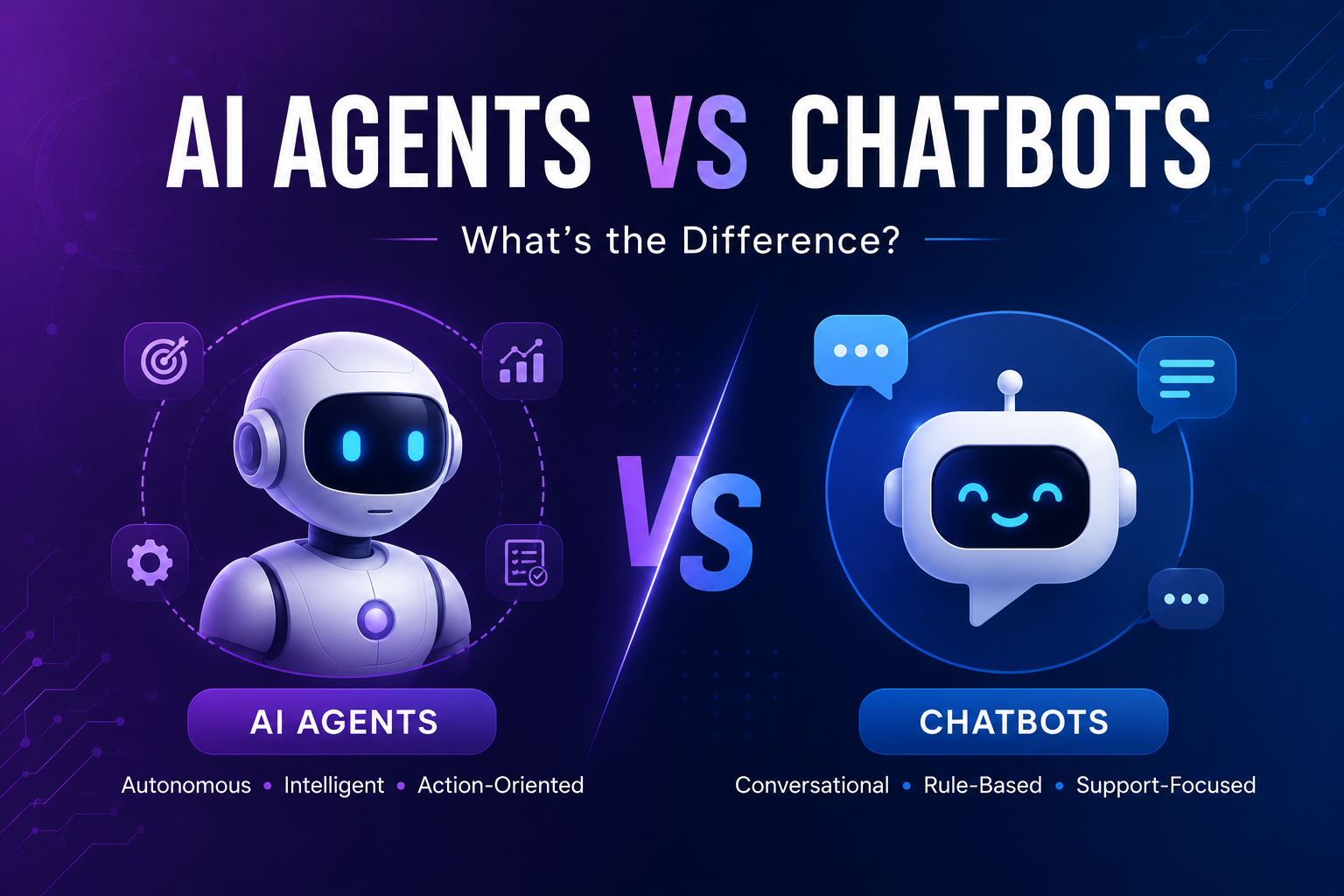
As artificial intelligence continues transforming business operations, many organizations are exploring automation technologies to improve customer support, streamline workflows, and enhance productivity. Two of the most commonly discussed AI solutions are chatbots and AI agents. While they may appear similar at first glance, they differ significantly in intelligence, autonomy, decision-making capabilities, and business applications.
Traditional chatbots are designed primarily to answer predefined questions and guide users through structured conversations. AI agents, on the other hand, can reason, learn from interactions, make contextual decisions, and perform tasks with minimal human intervention. As businesses increasingly invest in digital transformation and automation, understanding the differences between AI agents and chatbots has become essential for selecting the right solution.
This guide explores AI agents vs chatbots, their core capabilities, business use cases, implementation costs, advantages, limitations, and how organizations can determine which technology best aligns with their operational goals.
Understanding Chatbots
Chatbots are software applications designed to simulate conversations with users through text or voice interfaces. They are commonly deployed on websites, mobile applications, messaging platforms, and customer support portals to answer questions and assist users. Traditional chatbots operate using predefined rules and scripted conversation flows. More advanced AI-powered chatbots use Natural Language Processing to understand user intent and provide more conversational responses. Regardless of sophistication, most chatbots are designed to focus on communication rather than independent task execution.
A chatbot works by identifying keywords, matching user intent, and providing responses based on predefined logic. When a user submits a query, the chatbot analyzes the request and determines the most relevant response from its knowledge base. Modern chatbots may also integrate with customer databases, support systems, and CRM platforms to provide personalised information. Businesses commonly use chatbots for customer support, frequently asked questions, appointment scheduling, lead generation, product recommendations, and order tracking. These use cases involve predictable interactions where predefined workflows are sufficient to meet customer needs. One of the primary reasons organisations adopt chatbots is their affordability and ease of deployment. Chatbots provide immediate responses, operate twenty-four hours a day, and reduce the workload on customer support teams. They help improve customer satisfaction while lowering operational costs.
Understanding AI Agents
AI agents represent the next generation of intelligent automation systems. Unlike chatbots, AI agents are designed not only to communicate but also to reason, make decisions, and execute actions independently.
An AI agent is an autonomous software system capable of understanding goals, planning tasks, interacting with various tools, and completing complex workflows. Rather than simply responding to questions, AI agents actively work toward achieving objectives. Modern AI agents are powered by Large Language Models (LLMs), advanced memory systems, tool integrations, and multi-step reasoning capabilities. These technologies allow agents to understand context, retain information across interactions, access external systems, and perform actions based on real-time conditions.
For example, an AI sales agent can identify qualified leads, send personalized outreach messages, schedule meetings, update CRM records, and generate sales reports without requiring constant human supervision. Similarly, an AI customer service agent can investigate support issues, retrieve information from databases, provide solutions, and escalate complex cases when necessary.
Organisations are increasingly deploying customer service agents, sales agents, research agents, and workflow automation agents to improve productivity and reduce manual effort. Many businesses are investing in AI development services to build intelligent agents tailored to their operational requirements. These systems are particularly valuable in environments where tasks involve multiple steps, decision-making, and interactions across different software platforms. The biggest advantage of AI agents is their ability to automate complex business processes while continuously improving performance through learning and adaptation.
AI Agents vs Chatbots: Key Differences
Although AI agents and chatbots are both powered by artificial intelligence, they are designed for different purposes. Chatbots primarily focus on conversations and answering user queries, while AI agents can understand objectives, make decisions, execute tasks, and automate complete workflows.
The table below highlights the major differences between the two technologies:
| Feature | Chatbots | AI Agents |
|---|---|---|
| Primary Purpose | Answer questions and assist conversations | Achieve goals and complete tasks autonomously |
| Responses | Predefined or conversational | Dynamic and context-aware |
| Decision-Making | Rule-based logic | Intelligent, contextual decision-making |
| Learning Ability | Limited learning capabilities | Continuous learning and adaptation |
| Autonomy | Low | High |
| Task Execution | Provides information | Performs actions and executes workflows |
| Reasoning | Minimal reasoning | Multi-step reasoning and planning |
| Memory | Usually session-based | Usually session-based |
| Integrations | Basic integrations | Extensive integrations across systems |
| Scalability | Suitable for simple interactions | Suitable for end-to-end business automation |
| Data Handling | Mostly structured data | Structured and unstructured data |
| Human Intervention | Frequently required | Minimal supervision required |
| Business Impact | Improves customer service efficiency | Transforms operational efficiency and productivity |
In simple terms, chatbots are ideal for communication-focused tasks, while AI agents are designed for intelligent automation and business process execution.
Real-World Examples of Chatbots
Customer support chatbots are among the most widely adopted business applications of conversational AI. These systems answer frequently asked questions, provide order updates, assist with account management, and resolve basic customer concerns. By handling routine inquiries automatically, support teams can focus on more complex issues.
Banks frequently deploy chatbots to assist customers with balance inquiries, transaction history requests, credit card support, and branch information. These interactions are highly structured and can be efficiently managed through conversational automation. E-commerce companies also use chatbots extensively. Customers can receive product recommendations, track shipments, initiate returns, and obtain support without waiting for human assistance. These capabilities improve customer experiences while reducing support costs. While highly effective for these applications, chatbots generally struggle when conversations become complex or require decision-making beyond predefined workflows.
Real-World Examples of AI Agents
AI sales agents are becoming increasingly popular among organisations seeking to improve lead generation and sales efficiency. These agents can qualify leads, analyze customer interactions, schedule meetings, update CRM records, and recommend next actions based on buyer behavior. AI customer service agents provide significantly more advanced support capabilities than traditional chatbots. They can investigate support tickets, retrieve information from multiple systems, analyze customer histories, and resolve issues through intelligent decision-making.
Research agents are another rapidly growing category. These AI systems can collect information from multiple sources, summarize findings, identify trends, and generate detailed reports that would otherwise require significant manual effort. Workflow automation agents help organizations streamline repetitive business processes. These agents can process invoices, approve workflows, monitor compliance requirements, and coordinate activities across departments without constant supervision. As AI technologies continue to advance, AI agents are becoming increasingly capable of handling sophisticated business operations traditionally performed by human employees.
When Should Businesses Use Chatbots?
Chatbots are ideal for organizations seeking efficient solutions for routine customer interactions and basic process automation. Businesses should consider chatbots when their primary objective is FAQ automation, lead capture, appointment scheduling, or handling common customer service requests. Small and medium-sized businesses often find chatbots particularly attractive due to their lower implementation costs and relatively fast deployment timelines.
Organizations with moderate support volumes and predictable customer inquiries can achieve substantial benefits through chatbot deployment. These systems provide consistent responses, improve accessibility, and reduce response times.
However, businesses should recognize the limitations of chatbots. They typically require predefined workflows and struggle with complex reasoning, decision-making, and multi-step task execution.
When Should Businesses Use AI Agents?
AI agents are best suited for organizations seeking higher levels of automation and operational efficiency.
Businesses should consider AI agents when workflows involve multiple systems, complex decision-making, and task execution beyond simple communication. Enterprise operations, process automation initiatives, advanced customer support, and data-driven decision environments are particularly well suited for AI agents. The operational benefits can be substantial. AI agents reduce manual workloads, improve process consistency, accelerate decision-making, and enable employees to focus on higher-value activities. However, implementing AI agents often requires larger investments, stronger governance frameworks, and careful attention to security and compliance requirements. Organizations should evaluate their technology readiness and automation objectives before pursuing large-scale AI agent deployments.
Future of AI Agents and Chatbots
The future of business automation is increasingly centred around autonomous AI systems. Agentic AI is emerging as one of the most important developments in artificial intelligence. These systems can independently manage workflows, coordinate activities, and make decisions with minimal human oversight.
Generative AI is also transforming both chatbots and AI agents. Future solutions will provide more natural conversations, personalised interactions, and advanced problem-solving capabilities.
Organizations across healthcare, finance, manufacturing, retail, and professional services are rapidly expanding AI adoption. As technology matures, businesses will increasingly deploy multi-agent ecosystems where specialised AI agents collaborate to achieve organisational goals. The distinction between conversational interfaces and intelligent automation platforms will continue to blur as AI systems become more capable and interconnected.
AI Agents vs Chatbots: Cost Comparison
The cost of implementing chatbots and AI agents varies significantly based on complexity, integrations, security requirements, and business objectives.
| Solution Type | Estimated Development Cost |
|---|---|
| Basic Chatbot | ₹50,000 – ₹3 Lakhs |
| Advanced AI Chatbot | ₹3 – ₹10 Lakhs |
| Basic AI Agent | ₹5 – ₹15 Lakhs |
| Enterprise AI Agent | ₹15 Lakhs – ₹1 Crore+ |
Several factors influence the overall investment required. Integration with CRM, ERP, and third-party applications can increase development effort. Security and compliance requirements, particularly in industries such as healthcare and finance, may also impact costs. Additionally, the level of autonomy, workflow complexity, training data requirements, and ongoing maintenance needs play a significant role in determining the final budget. While AI agents require a higher upfront investment compared to chatbots, they often deliver greater long-term ROI through deeper automation, reduced manual effort, improved productivity, and more intelligent decision-making capabilities.
Which Is Right for Your Business?
Choosing between a chatbot and an AI agent ultimately depends on business objectives, budget, scalability requirements, and operational complexity. A chatbot is often the best choice for organizations seeking FAQ automation, customer support assistance, lead generation, and cost-effective conversational experiences. Businesses with limited budgets and straightforward requirements can achieve significant value through chatbot implementations. An AI agent is more appropriate when organisations need workflow automation, intelligent decision-making, cross-system coordination, and autonomous task execution. Businesses seeking enterprise-wide automation and operational transformation typically benefit more from AI agent deployments. Decision-makers should carefully evaluate their automation goals, technology infrastructure, growth plans, and customer experience requirements before selecting a solution.
Conclusion
AI agents and chatbots both play valuable roles iorganisationsn modern business automation, but they address different challenges. Chatbots excel at handling routine conversations, answering questions, and improving customer interactions. AI agents extend far beyond communication to include reasoning, decision-making, task execution, and the automation of complex workflows. As artificial intelligence continues evolving, organisations that understand these differences will be better positioned to invest in the right technology. Whether your goal is improving customer support, streamlining operations, or accelerating digital transformation, selecting the appropriate solution can significantly impact business performance, efficiency, and long-term growth.
Join our Newsletter
Get the latest tech insights delivered straight to your inbox.